Rohit Mukherjee, Ph.D.
I develop machine learning methods and satellite datasets to understand flooding, surface water, and urban environments.
I am a Postdoctoral Research Associate at Pacific Northwest National Laboratory, where I study global flood occurrence, urban vegetation, and urban representation in Earth system models.
For research collaborations and questions about my work, email rohitmukherjee@live.com.
Research
Global flooding and surface water
I study chronic flooding using a global 10-meter flood-occurrence dataset. I also develop GroundFlood-3K (imagery gallery), an approximately 3,000-chip flood benchmark.
My ongoing work uses Dynamic World weak labels, Sentinel-1 radar, and AlphaEarth embeddings to extend surface-water monitoring across sensors. I am developing human-in-the-loop post-training workflows for flood models and exploring applications to river-width measurement.
I also deployed a locally fine-tuned Sentinel-1 inundation model in a public application for the Rio Grande Valley.
Urban vegetation and environmental exposure
We are gathering air temperature, land cover, NDVI/EVI, and canopy-height metrics for CONUS and global urban areas.
Preprint: Background climate and socioeconomic conditions constrain global urban–rural contrasts in vegetation amount, subtype, and structure (Research Square preprint).
Urban climate and extremes
I develop global urban-surface datasets and methods to improve urban representation in the Department of Energy’s E3SM land model, integrating satellite remote sensing and machine learning.
My work includes data and model integration for urban extremes across U.S. coastal cities. I produced part of the underlying dataset for a multi-city study of how spatially continuous urban-surface properties affect heatwave simulations, currently under review at Journal of Advances in Modeling Earth Systems.
Urban Flood Observations
A NASA Terrestrial Hydrology Project (#80NSSC21K1341). PI: Beth Tellman.
Mapping urban floods is challenging because the urban landscape is complex and heterogeneous. To address this, we built Urban Flood Observations (UFO!), a hand-labeled dataset that captures urban flooding across 14 cities worldwide using PlanetScope imagery.
Preprint: Urban Flood Observations (UFO): A hand-labeled training and validation dataset of post-flood inundation (arXiv preprint, 2026).
Dataset: Zenodo
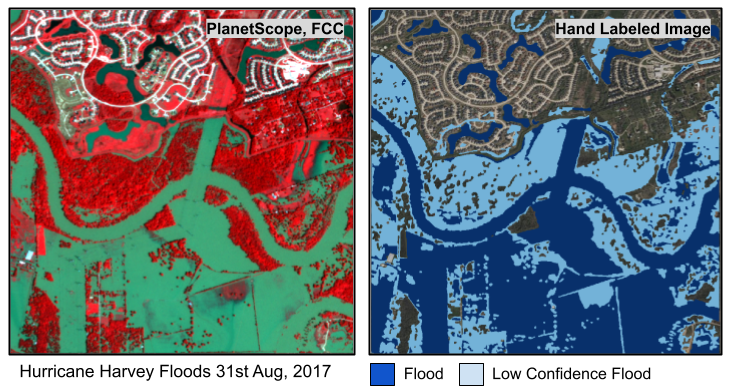
A sample from our training dataset built using Labelbox. Source: Planet.
My talk, Mapping Floods using Earth Observation and AI, on the IEEE GRSS YouTube channel.
NASA CSDA (#80NSSC21K1163) funded project on developing a global high-resolution hand-labeled flood extent mapping training and validation dataset called FloodPlanet.
Paper: Assessing inundation semantic segmentation models trained on high- versus low-resolution labels using FloodPlanet, a manually labeled multi-sourced high-resolution flood dataset (Journal of Remote Sensing, 2025).
topGlobal Surface Water Dataset
A NASA ACCESS Project (#80NSSC22K0744). In collaboration with Frederick Policelli and Beth Tellman.
I led the development of a globally sampled, hand-labeled validation dataset using PlanetScope imagery, published in Earth System Science Data in 2024. This work supports independent evaluation of satellite surface-water maps.
Paper: A globally sampled high-resolution hand-labeled validation dataset for evaluating surface water extent maps (Earth System Science Data, 2024).
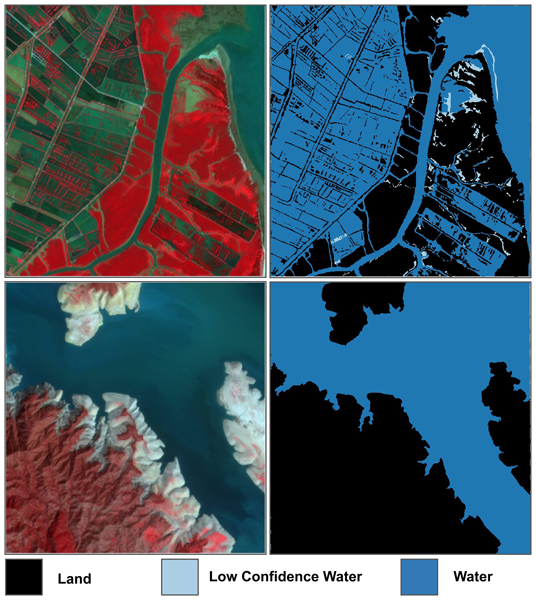
NASA CSDA (#80NSSC21K1163) funded project on evaluating BlackSky, where I am a Co-Investigator.
topDesert Floods in Pima County, Arizona
A Pima County Flood Control District project in Arizona.
This project focused on mapping fast-moving floods in the Sonoran Desert, which are difficult to capture with conventional surface-water methods. Instead, we used PlanetScope imagery to identify wet soils following rainfall events as a measure of flood extent. We then compared these results with the locations of recorded road closures to identify additional areas that may warrant road closures during future flooding.
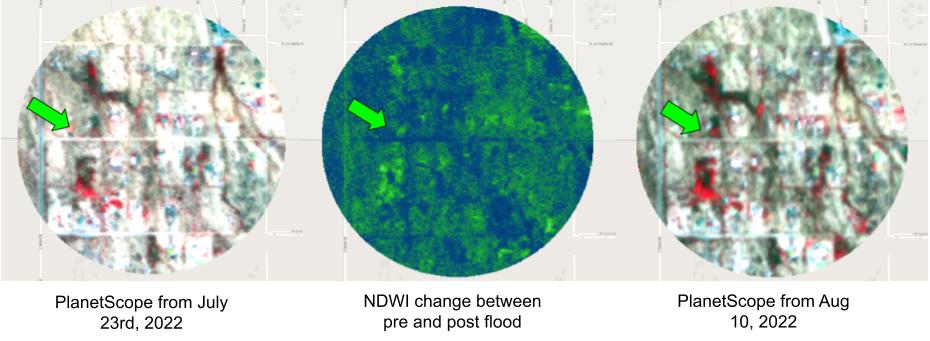
Identifying regions where it flooded, but there weren't any road closures for safety. Source: Planet.
topInformal Roads in Central America's Protected Forests
A NASA LCLUC Project (#80NSSC21K0297), in collaboration with Beth Tellman, Nicholas Magliocca, Matthew Fagan, Steven Sesnie, Erik Nielsen, Jennifer Devine, and Kendra McSweeney.
This project examines how narco-trafficking drives deforestation in Central America, using informal roads as an indicator. We developed a locally trained deep learning model that outperforms Microsoft and OpenStreetMap (OSM) in road identification. To analyze road growth since 2001, we use Landsat 7 alongside additional data sources to construct a counterfactual model assessing the impact of narco-trafficking on deforestation.
Paper: A data pedigree system to support geospatial analyses of human–environment interactions in data-poor contexts (International Journal of Geographical Information Science, 2025).
New paper: Narco-trafficking caused land-use change: The exceptional case of Costa Rica (Journal of Land Use Science, 2026).

Markers of narco-trafficking in Central America. Sources: Planet and ESA.
topAssessing Intervention Programs by USAID
Funded by USAID's Bureau for Humanitarian Assistance (BHA), in collaboration with the University of Arizona's Institute for Resilience (AIR) and the Economics and Sociology Departments.
This project develops metrics to assess the impact of BHA-funded programs delivered through local NGOs, which aim to drive behavioral and landscape changes, particularly in response to disasters. Our focus is on capturing landscape changes using satellite remote sensing, providing BHA with tools to evaluate the impact of these programs.
Paper: Humanitarian assistance and its expected behavior and land use changes: Insights from Bangladesh and Kenya (International Journal of Disaster Risk Reduction, 2026).
topDataset Releases
- Urban Flood Observations (UFO) Released
- Hand-labeled PlanetScope observations of urban flooding across 14 cities worldwide. Lead author.
Preprint: Urban Flood Observations (UFO): A hand-labeled training and validation dataset of post-flood inundation (arXiv preprint, 2026).
- Global surface-water validation Published · 2024
- A globally sampled, high-resolution, hand-labeled dataset for evaluating surface-water extent maps. Lead author.
Paper: A globally sampled high-resolution hand-labeled validation dataset for evaluating surface water extent maps (Earth System Science Data, 2024).
- FloodPlanet Published · 2025
- A manually labeled, multi-source high-resolution dataset spanning 19 flood events globally for evaluating inundation segmentation models. Co-author; NASA CSDA Co-Investigator.
Paper: Assessing inundation semantic segmentation models trained on high- versus low-resolution labels using FloodPlanet, a manually labeled multi-sourced high-resolution flood dataset (Journal of Remote Sensing, 2025).
Publications
Peer-reviewed publications
- Githu, D. W., Guido, Z., Goto, E. A., Hannah, C., Kamunge, J., Mutanda, E., Finan, T. J., Finan, P., Fox, K. M., Nelson, S., Sharma, P., & Mukherjee, R. Humanitarian assistance and its expected behavior and land use changes: Insights from Bangladesh and Kenya (International Journal of Disaster Risk Reduction, 2026). Article 106036.
- Saad, F., Mukherjee, R., Henebry, G. M., Schwartz, N., Jimenez, M., Lewis, T., & Fagan, M. E. Integrating optical and SAR data enables crown-level maps of an emergent tree species, Dipteryx panamensis (Remote Sensing Applications: Society and Environment, 2026). 42, Article 102076.
- Magliocca, N. R., Devine, J. A., Fagan, M. E., Aguilar-González, B., McSweeney, K., Mukherjee, R., Nielsen, E. A., Sesnie, S. E., & Tellman, B. Narco-trafficking caused land-use change: The exceptional case of Costa Rica (Journal of Land Use Science, 2026). 21(1), 349–366.
- Zhang, Z., Giezendanner, J., Mukherjee, R., Tellman, B., Melancon, A., Purri, M., Gurung, I., Lall, U., Barnard, K., & Molthan, A. Assessing inundation semantic segmentation models trained on high- versus low-resolution labels using FloodPlanet, a manually labeled multi-sourced high-resolution flood dataset (Journal of Remote Sensing, 2025). 5, 0575.
- Magliocca, N. R., Sink, C. D., Devine, J. A., Fagan, M. E., Aguilar-González, B., McSweeney, K., Mukherjee, R., Nielsen, E. A., Sesnie, S. E., & Tellman, B. A data pedigree system to support geospatial analyses of human–environment interactions in data-poor contexts (International Journal of Geographical Information Science, 2025). 39(6), 1223–1246.
- Mukherjee, R., Policelli, F., Wang, R., Arellano-Thompson, E., Tellman, B., Sharma, P., Zhang, Z., & Giezendanner, J. A globally sampled high-resolution hand-labeled validation dataset for evaluating surface water extent maps (Earth System Science Data, 2024). 16(9), 4311–4323.
- Mukherjee, R., & Liu, D. Spatial and spectral translation of Landsat 8 to Sentinel-2 using conditional generative adversarial networks (Remote Sensing, 2023). 15(23), 5502.
- Giezendanner, J., Mukherjee, R., Purri, M., Thomas, M., Mauerman, M., Islam, A. K. M., & Tellman, B. Inferring the past: A combined CNN–LSTM deep learning framework to fuse satellites for historical inundation mapping (Proceedings of the IEEE/CVF Conference on Computer Vision and Pattern Recognition (CVPR) Workshops, 2023). 2155–2165.
- Mukherjee, R., & Liu, D. Downscaling MODIS spectral bands using deep learning (GIScience & Remote Sensing, 2021). 58(8), 1300–1315.
- Patel, N., & Mukherjee, R. Extraction of impervious features from spectral indices using artificial neural network (Arabian Journal of Geosciences, 2015). 8(6), 3729–3741.
Preprints & manuscripts under review
Manuscript statuses updated September 3, 2026.
- Mukherjee, R., & Chakraborty, T. C. Evidence of chronic flooding from a global 10-meter flood-occurrence dataset. Nature (revised and resubmitted; back with referees). Dataset publicly released via Zenodo.
- Mukherjee, R., Friedrich, H. K., Tellman, B., Islam, A., Zhang, Z., Giezendanner, J., Lall, U., & Lakshmi, V. Preprint: Urban Flood Observations (UFO): A hand-labeled training and validation dataset of post-flood inundation (arXiv preprint, 2026). Dataset: Zenodo. Scientific Data (revised and resubmitted; in peer review).
- Mukherjee, R., & Chakraborty, T. C. Preprint: Background climate and socioeconomic conditions constrain global urban–rural contrasts in vegetation amount, subtype, and structure (Research Square preprint). In revision for One Earth.
- Jiang, T., Chakraborty, T. C., Cheng, Y., Mukherjee, R., Zhao, L., & Martilli, A. Impact of spatially continuous urban surface properties on heatwave simulations: A multi-city analysis. Journal of Advances in Modeling Earth Systems (under review).
- Leffel, B., Chakraborty, T. C., Mukherjee, R., Rodriguez Lombeida, A., & Song, K. H. Public rail transit shields global urban forests from expansionary pressures of car dependence. Nature Communications (in revision).
- Sun, T., Crank, P., Ding, Y., Doran, E., Mukherjee, R., et al. Rapid growth in urban climate science masks structural transferability gaps. Nature Cities (under review).
Technical Skills
- Machine learning: PyTorch, fastai, Hugging Face; CNNs, transformers, GANs, and geospatial foundation models.
- Python & geospatial packages: NumPy, pandas, xarray, Rasterio, GeoPandas, Shapely, GDAL, and geemap.
- GIS & Earth observation: Google Earth Engine, QGIS, ArcGIS, Microsoft Planetary Computer, NASA Earthdata/CMR, and ASF HyP3.
- Computing: HPC clusters and GPU computing (NERSC and university systems), Slurm, Google Colab, Docker, Lambda, and ASF OpenScienceLab.
- Development & annotation: Python, Jupyter notebooks, VS Code, Git/GitHub, Labelbox, and NASA ImageLabeler.
Mentoring & Contributions
I mentor researchers in applying machine learning to geospatial problems and help build the tools and shared practices that make this work possible.
- Student research at PNNL. Mentoring a high school researcher on satellite-based parking-lot mapping. We developed a pipeline using 400,000+ samples across 107 U.S. cities toward a nationwide 10-meter map of off-street parking lots.
- Graduate mentorship. Co-supervised four Ph.D. candidates at the University of Arizona. Built lab computing infrastructure, shared version-control practices, and hands-on deep learning training.
- Community & training. Organized the GeoAI Hackathon at PNNL TechFest 2026; co-convened IGARSS sessions in 2023 and 2026; delivered workshops on geospatial AI/ML and scientific research tools.
- Scientific service. Invited to the NASA Peer Review Panel (2023) to review research proposals for potential funding. Journal reviewer for npj Climate and Atmospheric Science, ISPRS Journal of Photogrammetry and Remote Sensing, and Water Security.
- College of Arts and Sciences Dean’s Student Advisory Board (2019-20): Provided feedback to the Dean of Arts and Sciences on graduate student issues and concerns.
- Delegate - Council of Graduate Students (2018-20)
Grant Proposals
- Co-wrote a successful proposal titled - "Enhancing the Evidence for Humanitarian Action (EEHA) in the Face of Climate Change" with Arizona Institute for Resilience, funded by USAID's BHA (total award: $1,000,000).
- Collaborated on internal grants at PNNL ($55,000 funded).
- Wrote four proposals that were not funded, including one for NASA's use of Capella SAR data.
PhD Dissertation
"Improving Satellite Data Quality and Availability: A Deep Learning Approach"
This research involved improving the quality (spatial, spectral resolutions) and availability (temporal resolution) of existing satellite image products using deep learning models. The study focused on utilizing techniques such as deep residual encoder-decoder networks and generative adversarial networks to enhance satellite images from sources like MODIS, Sentinel-2, and Landsat 8. The work is aimed to advance satellite image fusion methodologies for various applications.
Investigated several aspects of applying convolution networks and generative adversarial learning on satellite imagery. Asked and answered questions on optimal loss functions including adversarial learning. Demonstrated the advantages of fine tuning on your region of interest among several other insights! Spending hours deep learning training models (and failing most experiments) is at least helping me save time now.
Two peer-reviewed papers came out of this work:
- Paper: Downscaling MODIS spectral bands using deep learning (GIScience & Remote Sensing, 2021).
- Paper: Spatial and spectral translation of Landsat 8 to Sentinel-2 using conditional generative adversarial networks (Remote Sensing, 2023).
Awards
- Lakshmanan Chatterjee Fellowship for Outstanding PhD Student - Department of Geography, Ohio State University, 2019
- Cognizant Internal Awards - Individual and Team awards for reduction of operation cost through the development of Automation Tools, Cognizant Technology Solutions, 2014
Teaching Experience
- Fundamentals of GIS - SU17, SU18, SU19 (In-person), SU20 (Online)
- Geographic Applications of Remote Sensing - AU16, SP19, SP20 (Graduate)
- Spatial Systems and Modelling - AU19 (Graduate)
- Spatial Data Analysis - AU18 (Graduate)
- Mapping Our World - SP18 (Undergraduate)
- Cartography - AU17 (Graduate)
- Geospatial Databases - AU16 (Graduate)
- Guest Lectures: Geographic Applications of Remote Sensing - AU16, AU21 (in University of Arizona), SP19 (Graduate), Spatial Data Analysis - AU18 (Graduate).
Independently taught four summer graduate-level courses between 2017 and 2020, and served as a teaching assistant across a range of courses each semester. In response to the COVID-19 pandemic, converted an in-person GIS course to a fully online format on short notice. In an earlier role, led three weekly labs and graded assignments for approximately 144 students in a single course.
Student Evaluation of Instruction (SEI) scores improved over the course of the PhD, consistently exceeding departmental and university averages.
topEducation
- Ph.D., Geography, The Ohio State University
Focus Areas: Remote Sensing, Deep Learning
Advisor: Dr. Desheng Liu - M.Sc., Geo-Informatics, Birla Institute of Technology, Mesra, India
Thesis: "Extraction of Impervious Features through Artificial Neural Network using Spectral Indices"
Advisor: Dr. Nilanchal Patel
Patel, N., & Mukherjee, R. Extraction of impervious features from spectral indices using artificial neural network (Arabian Journal of Geosciences, 2015). 8(6), 3729–3741. - B.Sc., Computer Science, St. Xavier's College, Kolkata, India
Thesis: "A Social Networking Website for Academics (SharEd)"
Industry Experience
Cognizant Technology Solutions, Programmer Analyst, 2013 - 2015.
Developed a VBA script to extract data from a legacy DOS application used for ESCROW processing, automating manual data entry and reducing processing time by approximately 85%. Also built a web-based interface for ServiceNow ticket processing using C# and ASP.NET.
topField Work
Visited Costa Rica in the summer of 2023 with Prof. Matt Fagan and graduate students to collect training and validation data for mapping land use/cover and roads.
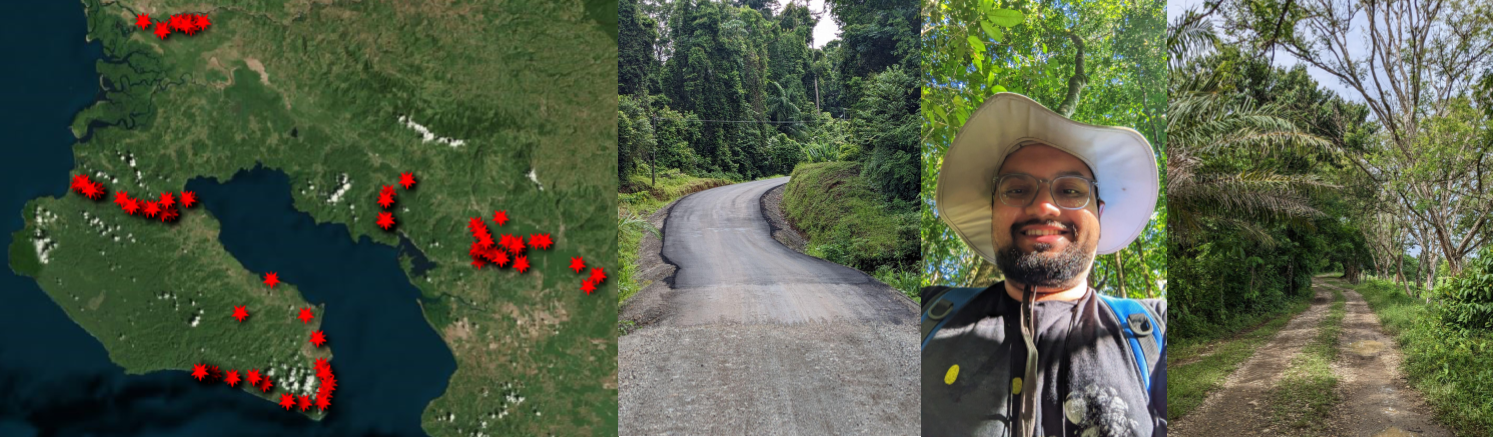
From left to right: all collected road validation points in the Osa Peninsula, Costa Rica; unpaved roads constructed from asphalt and gravel sourced from nearby rivers, which frequently leads to misclassification between the two surface types; a field site in Corcovado National Park; and roads bordering oil palm plantations.
top